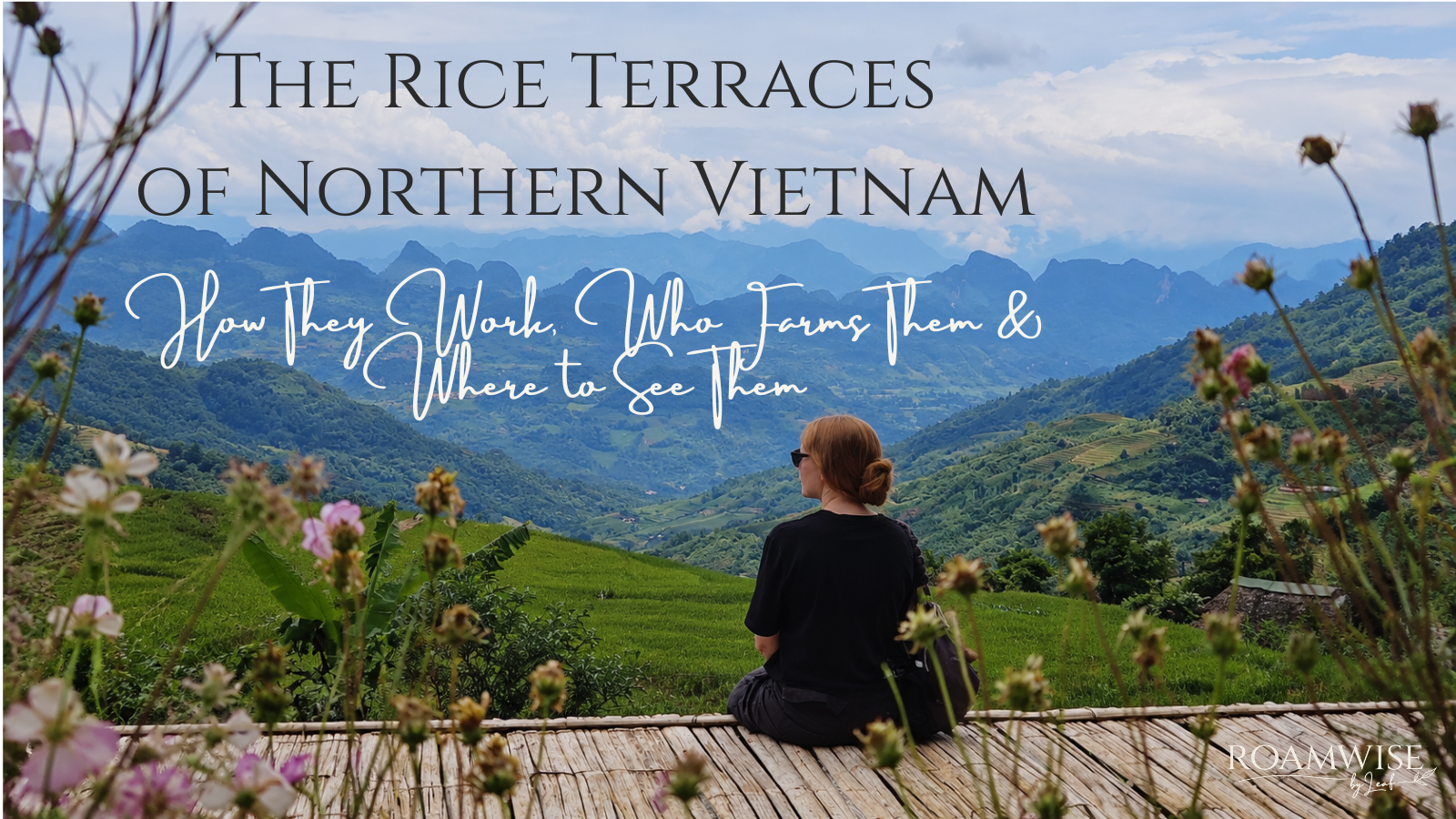
If you’ve ever looked at the rice terraces of Northern Vietnam and wondered how on earth anyone built them, you’re not alone.
I’ve spent a lot of time travelling through the north, and I’ve watched people plant rice by hand in thick mud, harvest it, dry it in the sun, and carry it home.
The more I’ve seen, the more I’ve realised that these terraces are far more interesting than the surrounding mountain view.
So, how do they work, who farms them, and where should you go to see the best ones?
When to go
September–October is generally the time to visit if you want to see golden rice terraces, although exact harvest dates vary by location and altitude.
Hoang Su Phi is generally at its best around September and October, while places such as Xa Phin can be later in the season.
You can also visit during planting season, when flooded terraces reflect the sky and mountains, or during the growing season when the fields are bright green.
Personally, though? I’d take the golden season.
Why Do Rice Fields Need to be Terraced?
This is probably the question I would have asked first if I hadn’t simply accepted the landscape as something that had always been there.
The short answer is: the mountains are too steep for conventional wet-rice farming.
Rice grows well with its roots in shallow water, but on a steep mountainside that water would simply run downhill.
So instead of trying to farm the mountain as one enormous slope, farmers have created a series of relatively level fields, one above another.
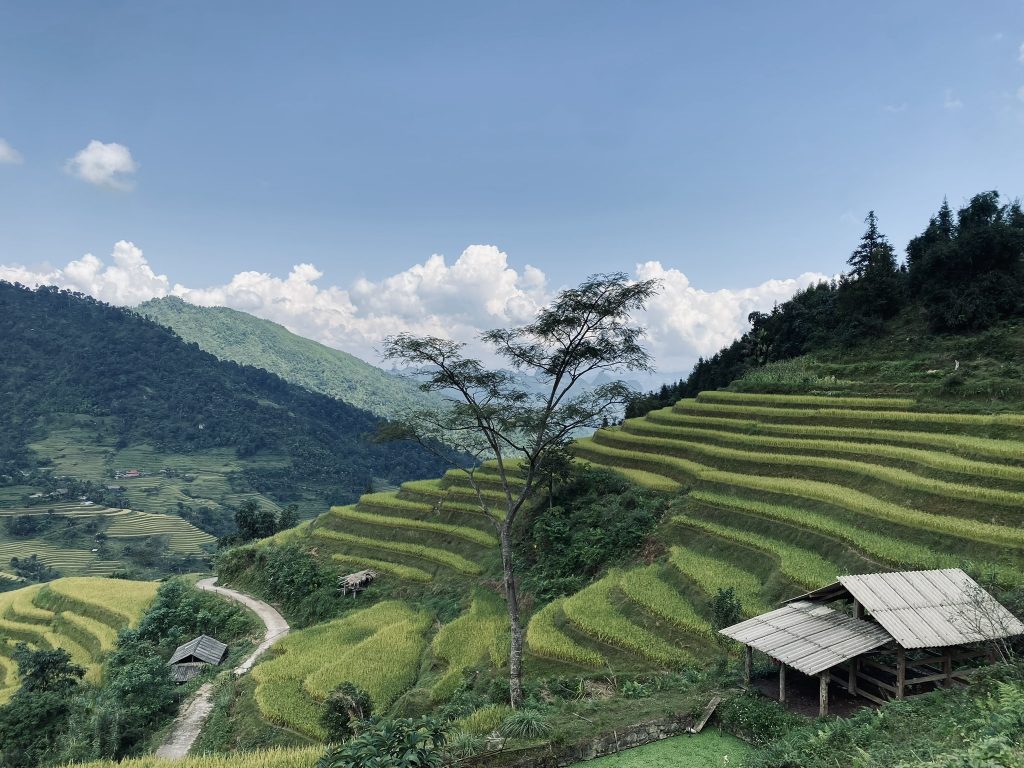
Each terrace has an earth or stone bank around it to retain water, while irrigation channels help move water through the different levels.
The terraces solve several problems at once. They allow farmers to:
- create usable agricultural land on steep slopes
- retain and control water
- reduce water rushing straight downhill
- help limit soil erosion
- make use of land that would otherwise be extremely difficult to cultivate
The terraces don’t make the mountains less steep. They make the mountains farmable.
And that’s something I think is easy to miss when you’re looking at them from a viewpoint.
If you’re particularly interested in how the landscape and communities of Ha Giang have developed, my guide to the history of the Ha Giang Loop goes into much more detail.
How are the Rice Terraces of Northern Vietnam Made?
This is the bit I’m most interested in because, honestly, standing beside one makes you realise how much work must have gone into creating it.
These aren’t naturally occurring steps in the mountains.
They’re agricultural systems that have been created and maintained by people over generations.
The exact construction varies according to the landscape, soil, and local farming practices, but the basic idea is surprisingly straightforward.
First, a suitable section of mountainside has to be worked into a relatively level area. The soil is cut and moved to create the terrace, with a bank formed around the edge to hold everything in place.
Those banks can be made from compacted earth, stone, and other locally available materials. Traditional systems can also use things such as bamboo or branches.
Then comes the really important part: water.
The terraces aren’t just a series of pretty steps. They’re connected.
Water is brought into the fields and managed so that it can move through the different levels rather than disappearing straight down the mountainside. Traditional irrigation systems use natural water sources, including streams, with channels and pipes helping move water through the fields.
And once you’ve built a terrace, the work isn’t finished.
The banks need maintaining. Water channels need managing. Soil needs preparing. Fields have to be planted, tended, and harvested.
It’s not a landscape that was built once and left alone; it’s continually maintained.
That’s probably the biggest thing I hadn’t appreciated before spending time around the fields.
From Planting to Harvest: What Actually Happens?
Preparing the Rice Fields
Before the rice is planted, the terraces have to be prepared for another growing season.
Farmers first need to clear and repair the fields, including fixing sections of terrace bank that have eroded and making sure water can move through the irrigation system properly.
Then the soil is worked and loosened. Traditionally, this could involve hand tools or animals such as water buffalo pulling a plough, particularly on steep, narrow terraces where larger machinery isn’t practical.
Buffalo are still used by some farmers in the northern uplands, while mechanical ploughs are also used where the terrain and farming system allow.
Once the soil has been prepared and the fields are ready, water is brought into the terraces.
And this is where the landscape starts to look very different.
Planting the Rice
This is one of the stages I’ve watched most closely.
People work their way through the flooded terraces, planting seedlings by hand into the mud. It’s much more physical than the finished landscape suggests.
From the road, you see neat rows of green plants. You don’t necessarily think about the fact that somebody had to stand in that mud and put them there.
Traditional rice transplanting remains an important part of terrace farming in the northern mountains, although planting times vary depending on the location and growing season.
I’ve watched farmers moving through the terraces section by section, working in conditions that look considerably less comfortable than the finished fields make them appear.
The Mirror Season
Around the same time as planting, the flooded terraces can become almost completely reflective.
This flooded period is often described as the “mirror season”, when the water-filled fields reflect the sky and surrounding mountains.
Depending on the location and timing, you may see the terraces before the seedlings have been planted or while farmers are already working their way through the flooded fields.
The timing varies by location, but late May to early June is generally when you’ll see the terraces at their most reflective.
I actually think this is one of the best times to understand how the terraces work. Without mature rice covering the fields, you can clearly see the water being held across all those carefully shaped levels.
As the seedlings take hold and begin to grow, the reflections gradually disappear beneath the green rice.
Growing the Rice
Once planted, the terraces gradually turn green.
This is when the landscape looks completely different from the golden fields you see in photographs of harvest season.
Water management remains important throughout the process, and farmers have to keep the terraces and their banks in good condition.
The whole system relies on knowing the land extremely well.
And that knowledge isn’t something that appeared overnight. Terrace farming has been maintained and adapted across generations.
Harvesting the Rice Terraces of Northern Vietnam
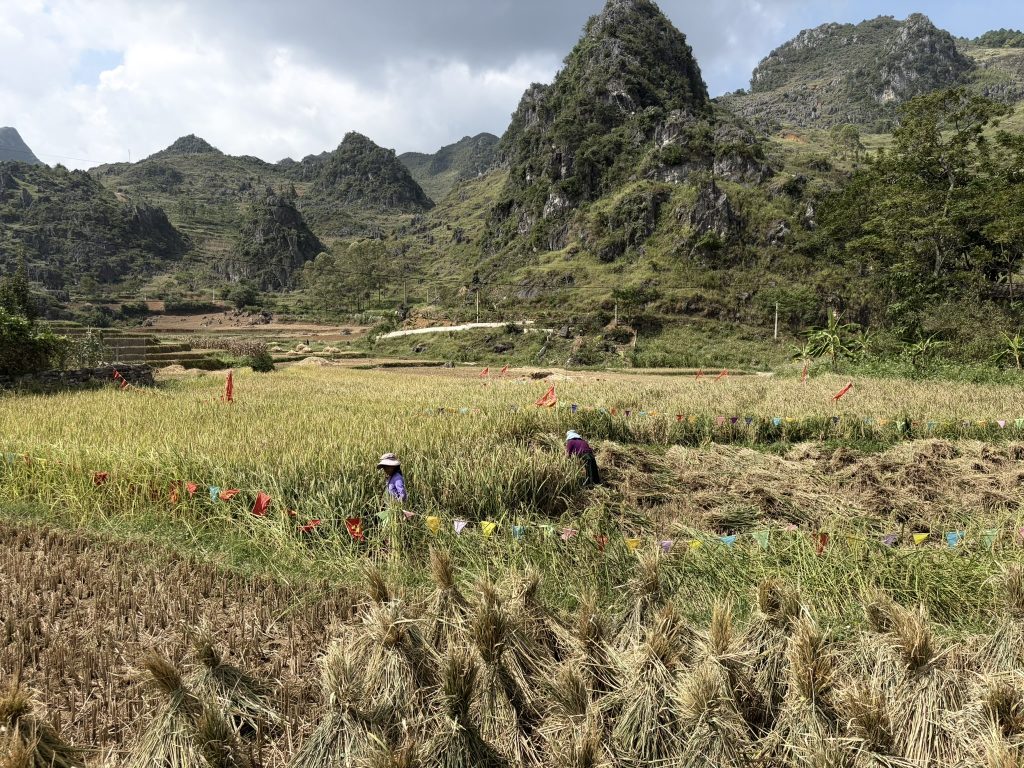
Then comes the part everyone photographs — the rice turns golden and eventually it’s time to cut it.
I’ve watched people cutting the rice, gathering it together, and carrying it away from the fields.
And this is where something else I noticed started to make me curious.
Where are all the men?
Rice farming also brings seasonal changes to the northern landscape. After the harvest, some farmers burn leftover rice straw, which can leave blackened patches across the fields. I’ve written more about agricultural burning in northern Vietnam and when it happens.
Who Actually Farms the Rice Terraces of Northern Vietnam?
One of the things I’ve noticed while travelling through Northern Vietnam is how often the people I see doing the most visible, hands-on work in the rice fields are women.
But the answer isn’t simply that women farm the rice and men don’t.
Different stages of the work involve different people, and the division of labour can vary between communities and households.
From what I’ve observed and learned, men can be particularly visible during heavier preparation work, while women can be particularly visible during tasks such as transplanting and tending the rice. Harvesting can involve both men and women.
That actually makes sense of something I had noticed.
I’m often seeing the fields during planting or tending, rather than seeing every stage of the agricultural cycle.
And during harvest, the distinction becomes even less obvious.
I’ve watched people cutting and gathering the rice, then carrying it away from the terraces once the work is finished.
So if you’re travelling through the mountains and wondering where the men are while a field full of women is planting rice, the answer may simply be that you’re looking at one particular part of the farming process.
It’s a good reminder that what you see from the roadside is only a tiny snapshot of how a household makes its living.
What Happens to the Rice After it is Cut?
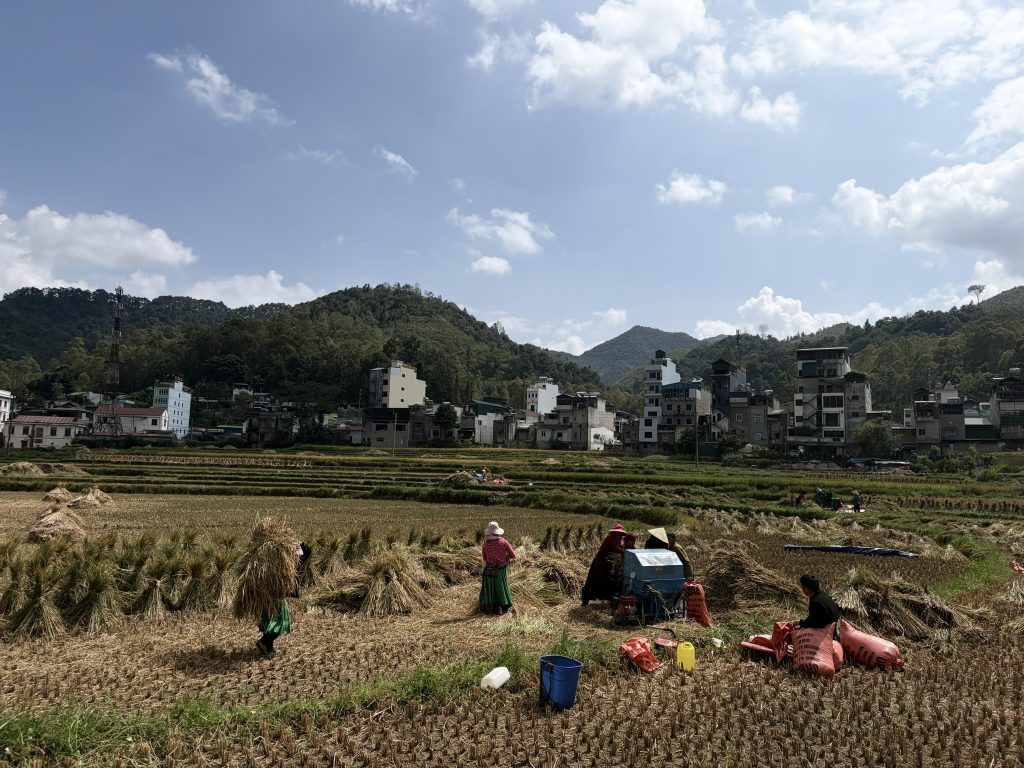
The harvest doesn’t end when the rice is cut. The grain still needs to be separated from the stalks — a process known as threshing.
In some places, this is done by hand in the fields, while machinery is also used. Once the grain has been separated, it is spread out to dry in the sun. Depending on the farmer and the location, you may see this happening in the fields or along the roadside.
When the rice is dry, it is gathered into large red bags and carried home, while the remaining rice stalks may then be burned in the fields.
There’s something oddly satisfying about seeing this part of the process because, by then, the golden landscape suddenly makes sense.
Those fields didn’t turn golden for the benefit of tourists. That’s the crop. It’s the end result of months of work.
💡 Roamwise Tip
Practices vary between farmers and locations, so I wouldn’t assume that every field is treated in exactly the same way.
Why Rice Matters So Much in Northern Vietnam
Rice is obviously important throughout Vietnam — it’s a staple of the Vietnamese diet and a major agricultural crop.
But in the northern mountains, rice terraces have another layer of importance.
For many communities, the terraces are a source of food and livelihood, as well as being part of a much older relationship with the land.
The rice terraces of Northern Vietnam have been built and maintained by different ethnic communities, including H’Mong, Dao, Tay, and Nung peoples, depending on the region.
And the rice itself isn’t simply a crop in the background.
In places such as Ha Giang or Sapa, rice and the terraces have played an important role in the lives and culture of the local community for generations.
This is why I think it’s worth learning a little about the terraces before visiting them.
Otherwise, you’re looking at an incredible landscape without necessarily understanding why it exists.
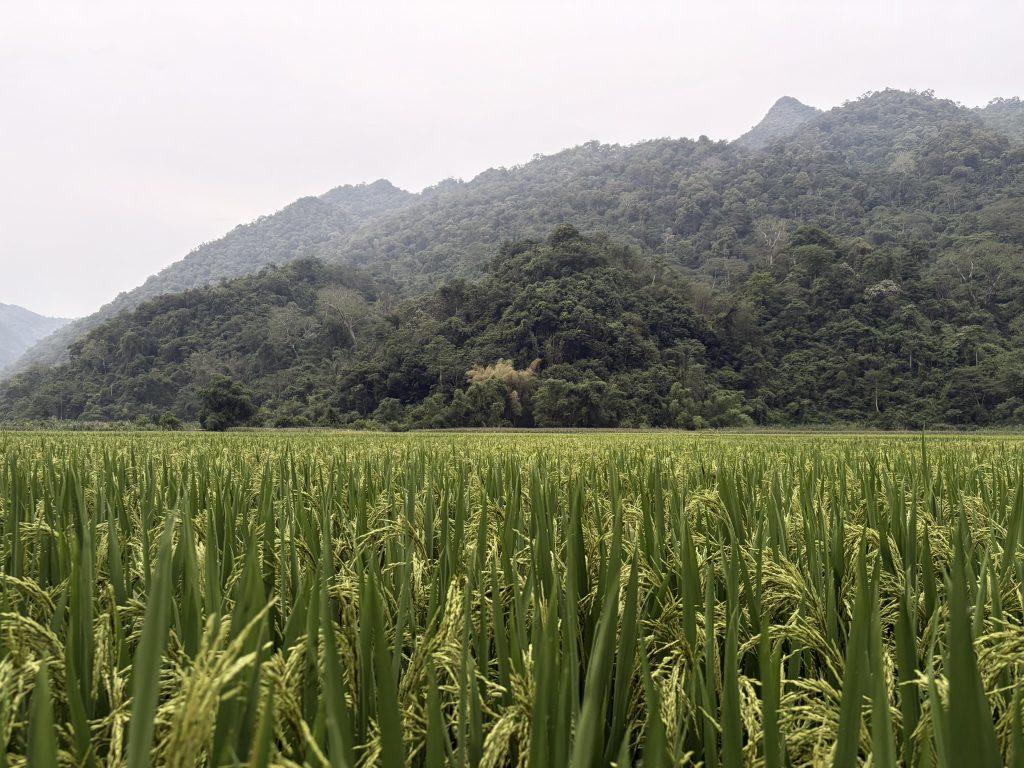
Where to See the Rice Terraces of Northern Vietnam
There are plenty of places where you can see the rice terraces of Northern Vietnam, but I wouldn’t try to visit every famous terrace destination just so you can say you’ve ticked them off.
If I were planning a trip around the rice terraces, these are the places I’d pay attention to.
Hoang Su Phi
This is my number-one recommendation.
I’ve been to Hoang Su Phi independently rather than simply passing through on a Ha Giang Loop itinerary, and in my opinion, this is a much better place to appreciate the rice terraces than simply seeing them from the Loop.
Hoang Su Phi is spread across the western part of Ha Giang, with huge areas of terraced farmland running through different mountain communities.
The scale is impressive, but what I particularly like is that the terraces don’t feel like one neatly packaged tourist attraction.
They’re spread across the landscape.
The terraces here have been built and cultivated by different ethnic communities for generations, including Nung, Dao, Tay, and La Chi communities. Hoang Su Phi’s terraces were recognised as a national heritage site in 2012.
Go in September or October if you want the golden fields.
If you have time, I’d stay rather than simply drive through. This is somewhere I’d give myself a little time to explore, walk around and actually watch the agricultural landscape rather than rushing between viewpoints.
And because the area is so spread out, having a local place to stay or guide can make much more sense than trying to see everything independently in a single day.
Sapa
Sapa is probably the easiest place to see rice terraces if you’re looking for an established tourist destination with plenty of accommodation and trekking options.
The Muong Hoa Valley is the main area, with terraces around villages including Lao Chai and Ta Van. The terraces here have been cultivated by H’Mong and Dao communities for generations.
The advantage is convenience.
The disadvantage is that Sapa is much more developed and touristy than places such as Hoang Su Phi.
I’d choose Sapa if convenience matters to you. I wouldn’t choose it purely because someone told you it’s the best place to see rice terraces.
💡 Roamwise Tip
If you’re choosing between Hoang Su Phi and Sapa, I’d personally choose Hoang Su Phi for the quieter experience and more immersive landscape, while Sapa makes more sense if convenience and established trekking infrastructure are your priorities.
Mu Cang Chai
Mu Cang Chai is one of the most famous rice-terrace destinations in Vietnam, and for good reason.
The terraces here are enormous and particularly impressive around areas such as La Pan Tan and Che Cu Nha.
If your priority is huge, dramatic terrace landscapes, this is one to consider.
The terraces are cultivated by H’Mong, Dao, and Tay communities, and the main harvest period is generally around September and October, although the precise timing varies.
I think Mu Cang Chai makes more sense if you’re specifically planning a trip around the rice terraces rather than trying to squeeze it into an already packed Northern Vietnam itinerary.
If you’re planning a wider trip through the region, my Northern Vietnam travel guide covers the places I’d prioritise and how I’d put them together.
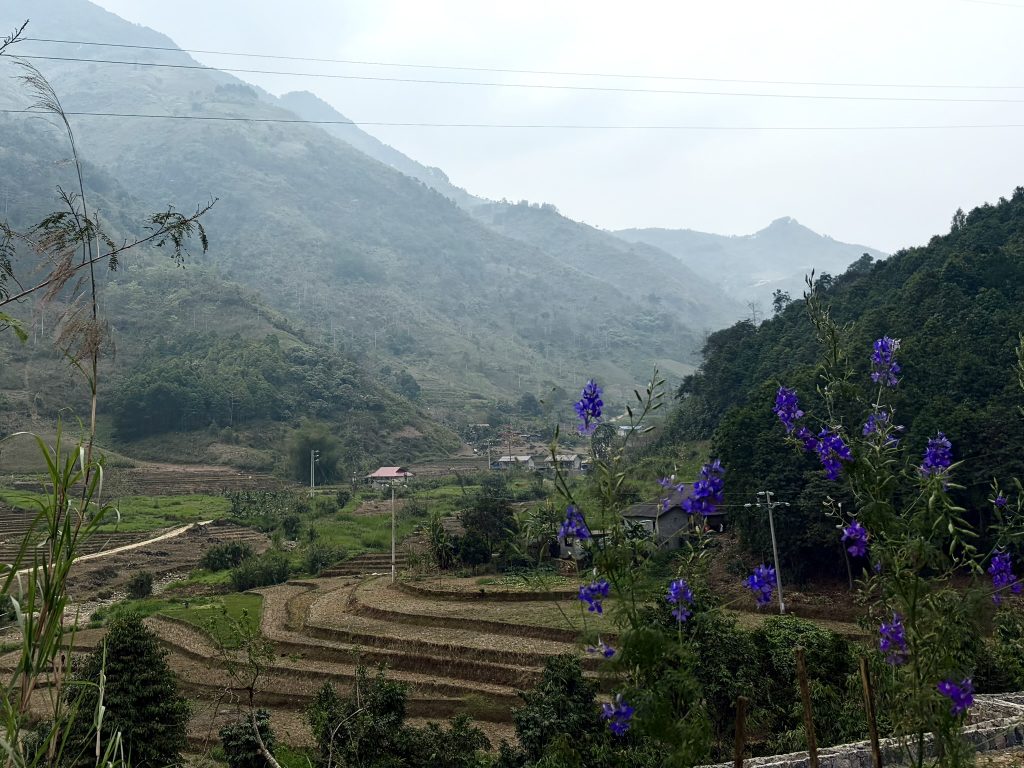
My Top Off-the-Radar Rice Terraces in Northern Vietnam
Xa Phin, Near Ha Giang City
If you want somewhere that still feels genuinely off the beaten path, I’d look at Xa Phin.
I visited independently and barely saw another traveller.
It’s a small village surrounded by rice terraces and mountains, and that’s part of what makes it so appealing to me. You’re not arriving somewhere where the main experience is competing with a stream of tour groups for the same viewpoint.
You’ll need to reach Xa Phin by motorbike, but you can rent one in Ha Giang City. I used Style Motorbikes, and once you turn off the main highway, the road becomes very bumpy but sees very little traffic. It’s much more about taking your time than rushing to get there.
The rice terraces are incredible, but they’re not the only reason I’d make the journey.
If you continue higher into the hills, you’ll eventually reach tea plantations and little tea shops. I thought that was particularly cool because it gives you another reason to explore beyond the rice fields themselves.
The rice season here can also be slightly later than in some other northern destinations, with harvest around mid-October.
It’s my wildcard recommendation for anyone who has already seen the obvious Northern Vietnam rice field destinations and wants somewhere that still feels like a discovery.
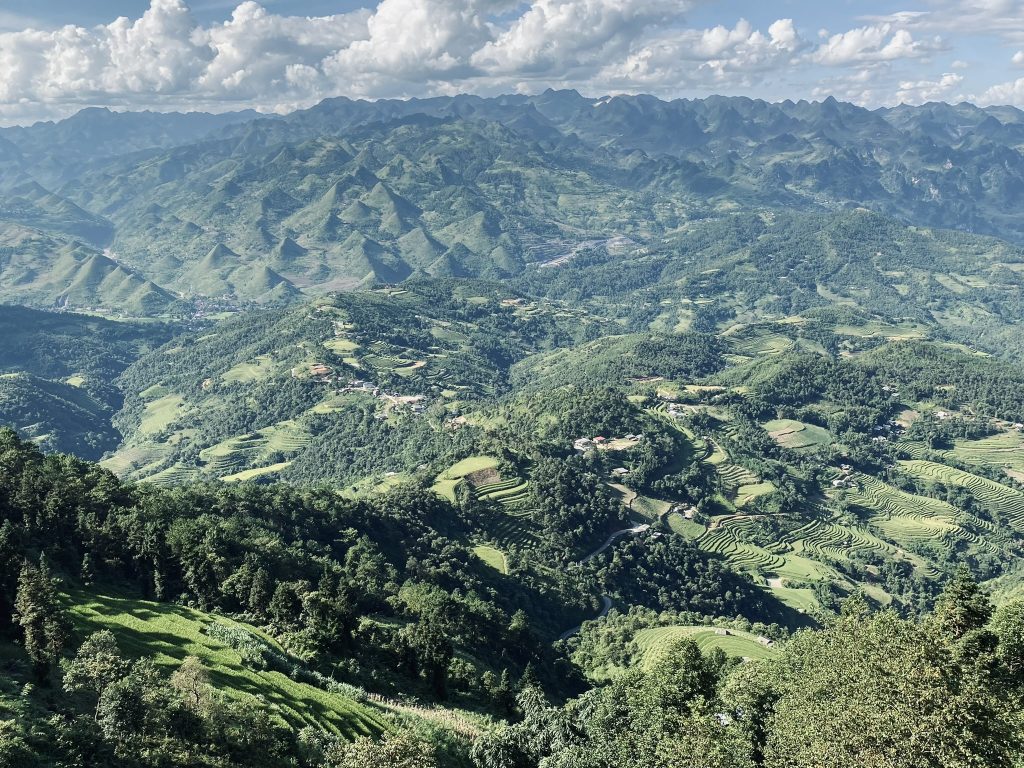
Ngoc Long Valley, Ha Giang Loop
If you’re already travelling the Ha Giang Loop, there’s one rice-terrace viewpoint I’d make a note of.
Around Ngoc Long Valley near Mau Due, you can take a tiny dirt track up into the hills to reach a viewpoint overlooking the valley and its rice terraces. The view from the top is stunning, and it’s one of those places that’s easy to miss if you’re simply following the main road.
I’d go earlier in the day, before the tour groups arrive. When I visited, getting up above the valley gave me a completely different perspective on the terraces below.
There is one important caveat: I wouldn’t recommend the track to inexperienced riders. It’s narrow and rough, so I’d only attempt it if you’re a confident driver or have hired an Easy Rider (local driver).
It’s not somewhere I’d travel across Northern Vietnam specifically to visit, but if you’re already doing the Ha Giang Loop independently, it’s absolutely worth knowing about.
How to Visit the Rice Terraces Respectfully
This is still people’s farmland, so I’d treat the terraces accordingly.
- Don’t walk through planted rice simply because you want a photograph
- Don’t climb onto terrace walls if doing so could damage them
- And if you’re photographing farmers, ask first
I’ve seen enough people pointing cameras at people working to know that it’s easy to forget you’re photographing someone’s workplace rather than a tourist attraction.
If you want to understand the terraces properly, I’d also consider staying in a local homestay or using a local guide where appropriate.
Community-based tourism can put money directly into villages and gives you a much better chance of understanding the landscape beyond the viewpoint.
Most importantly, remember that the rice terraces don’t exist for tourists. We’re visitors in a landscape that people depend on for their livelihoods.
A lot of this comes down to understanding that you’re visiting people’s homes and workplaces, something I also talk about in 23 things I wish I knew before travelling Vietnam.
FAQs About the Rice Terraces of Northern Vietnam
Why are rice fields terraced in Northern Vietnam?
The mountains are too steep for conventional wet-rice farming. Terracing creates relatively level fields that can retain and manage water while making steep slopes usable for agriculture.
How are rice terraces made?
Farmers cut and level sections of the mountainside, create retaining banks from materials such as earth and stone, and build irrigation systems to move water through the terraces. The terraces then require ongoing maintenance.
Who farms the rice terraces?
Different ethnic communities farm the terraces across Northern Vietnam, including H’Mong, Dao, Tay, Nung and La Chi communities, depending on the region. Farming work can be divided between men and women, with both involved in different stages of the process.
When are the rice terraces golden?
Generally, September and October are the best months for golden rice terraces in much of Northern Vietnam, although the exact timing varies by location and elevation.
Where can I see the best rice terraces of Northern Vietnam?
My personal picks are Hoang Su Phi and Xa Phin. Sapa is the easiest option for travellers, while Mu Cang Chai is one of the most dramatic and famous terrace landscapes.
Can I see rice terraces outside September and October?
Yes. The terraces look completely different throughout the agricultural year. During planting season they can be flooded and reflective, while the growing season turns them green.
Can I walk through the rice terraces?
Only where it is appropriate and permitted. Remember that the terraces are working farmland, so stick to established paths and don’t enter planted fields or climb terrace walls for photographs.
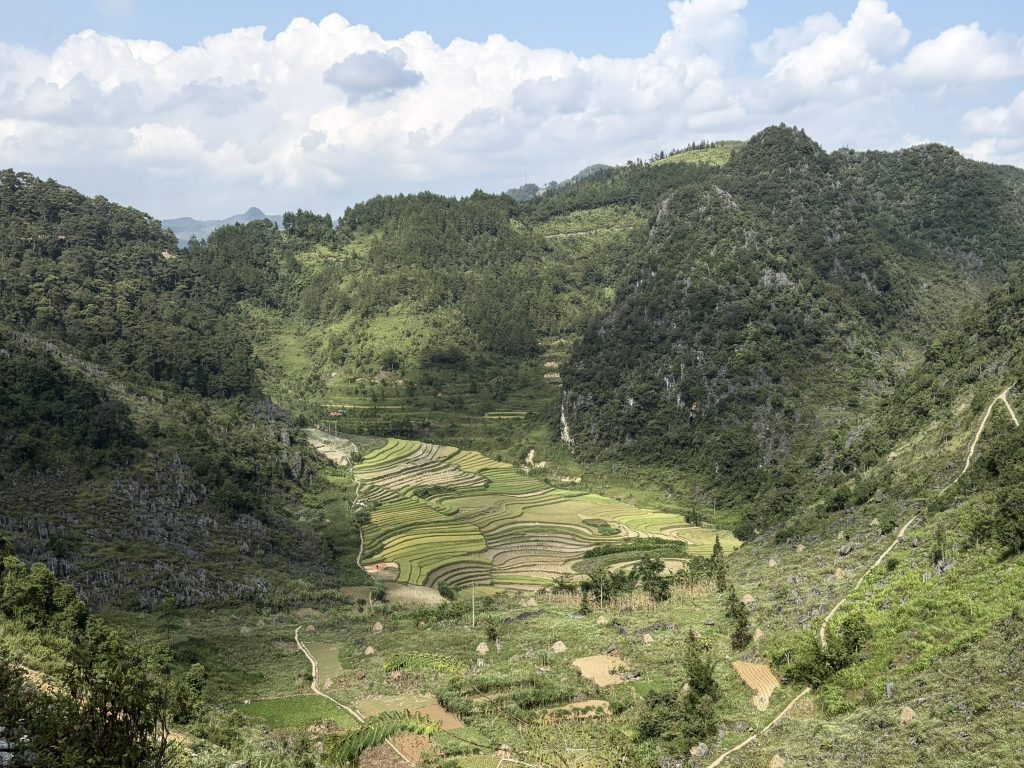
The rice terraces of Northern Vietnam are beautiful, but I think they’re far more interesting once you understand what you’re actually looking at.
They’re working farmland, shaped and maintained by generations of people who have figured out how to grow food on steep mountainsides.
Once you see the planting, the harvesting, the drying, and all the work that happens between those stages, the terraces stop looking like scenery and start looking like what they really are: a living agricultural landscape.
Hoang Su Phi is where I’d go first. Xa Phin is the place I’d tell a friend about afterwards.
And when you’re standing beside those terraces, take a minute to watch the people actually working them. That’s the part of the landscape you won’t see from a viewpoint.
Roamwise by Leaf — Practical guides | Forgotten stories | Meaningful journeys