
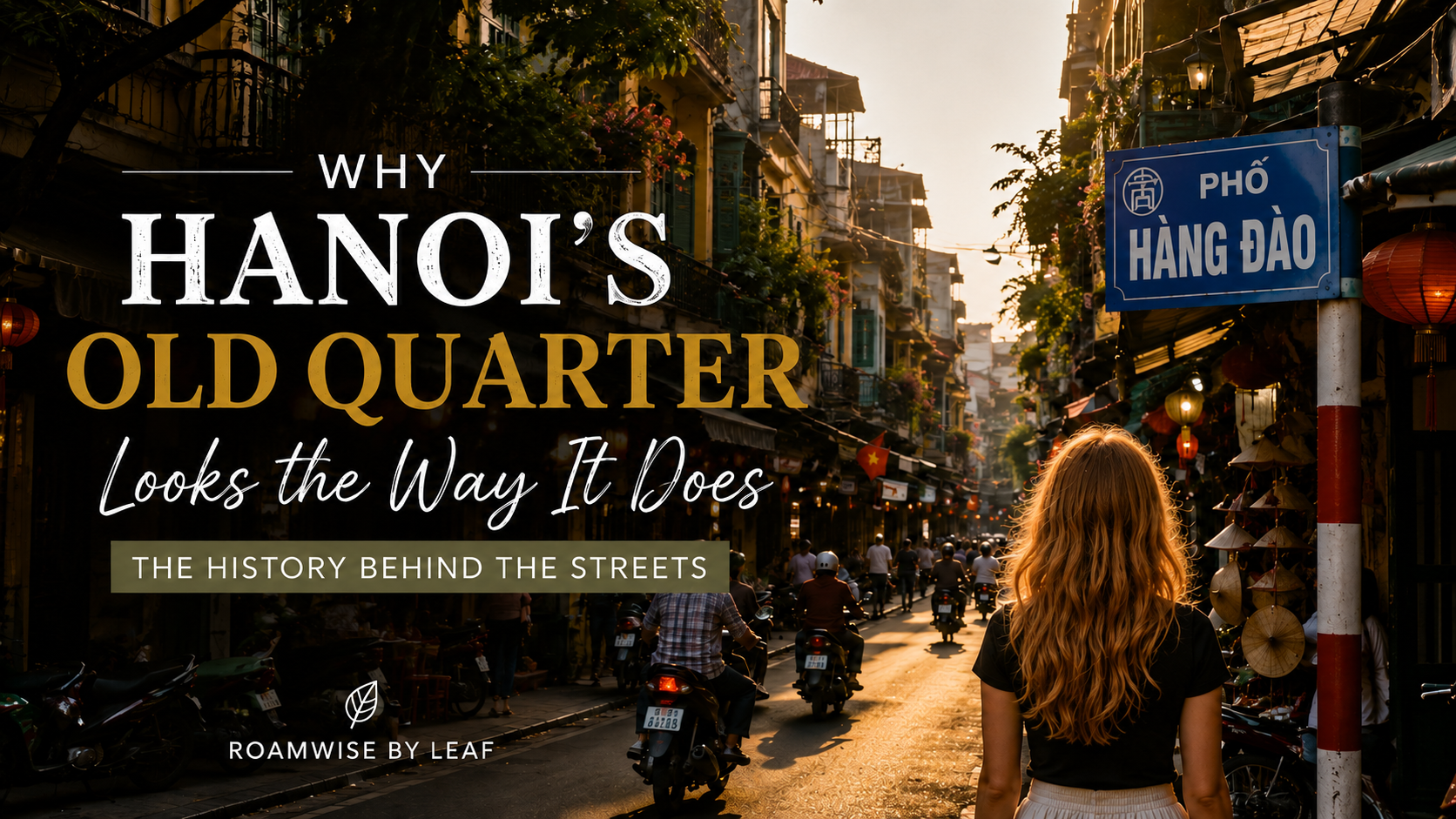
I’ve walked through Hanoi Old Quarter enough times that I’ve stopped noticing some of the things that make it look so unique.
The ridiculously narrow streets. The buildings that look about three metres wide but seem to disappear backwards forever. The fact that you can turn a corner and suddenly find yourself surrounded by shops selling essentially the same thing.
For ages, I just accepted it as Hanoi being Hanoi.
But once you actually stop and ask why the Old Quarter looks the way it does, there’s a surprisingly good explanation for most of it.
The streets weren’t laid out randomly. The houses aren’t narrow because somebody was trying to make architecture unnecessarily difficult. And those slightly suspiciously specific street names aren’t just there to rage bait Google Maps.
They’re clues to the way this part of Hanoi developed.
The Old Quarter grew as a dense commercial district around the imperial capital of Thăng Long, with craftspeople and merchants settling together, specialising in particular trades and building their lives around them.
Later, taxation, French colonial development, war, economic reform, and modern tourism all added new layers.
So this isn’t really a story about old buildings.
It’s a story about why the city looks the way it does—and how much of Hanoi’s history you can still see simply by walking down the street.
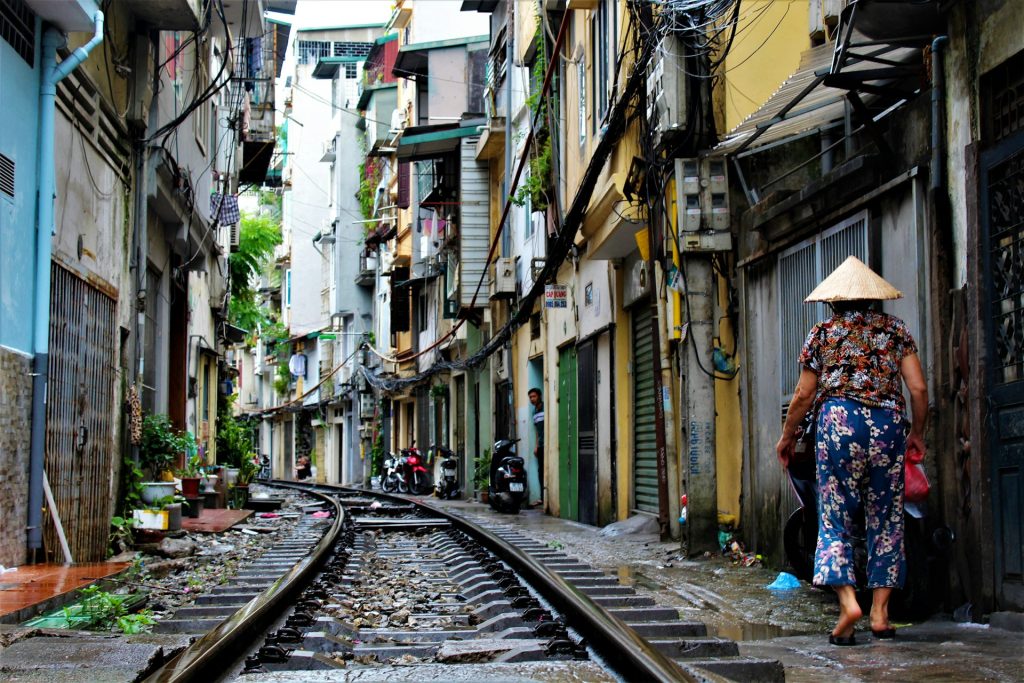
History of Hanoi Old Quarter
The area we now call Hanoi’s Old Quarter developed east of the Imperial Citadel of Thăng Long, after Emperor Lý Thái Tổ moved Vietnam’s capital from Hoa Lư to Đại La in 1010 and established the new capital of Thăng Long.
That move matters because a capital needs more than a palace. People had to live there, goods had to be made and sold, craftspeople were needed, and merchants arrived.
Over the Lý and Trần dynasties, the area that is now the Old Quarter became increasingly densely settled as people from the surrounding plains moved into the growing city.
The landscape was also very different from today’s dense city. The area contained lakes and wetlands, and waterways connected the neighbourhood with Hoàn Kiếm Lake and the Red River before those connections were gradually isolated towards the end of the 19th century.
Among those arriving were craftspeople and merchants from villages around northern Vietnam, bringing their trades with them. They helped establish the Old Quarter as a dense commercial district where people lived and worked close to one another.
These communities also brought their religious traditions with them. Temples, communal houses, and shrines were built alongside the commercial areas, some associated with the founders or patron figures of particular crafts.
The result wasn’t a neighbourhood that was designed all at once. It was a neighbourhood that grew around the people using it.
That’s why understanding the history is so useful here. If you only look at the Old Quarter as a collection of old streets and buildings, it can seem chaotic.
If you look at it as a medieval commercial district that kept evolving for centuries, the chaos starts to look rather more organised.
Hanoi Old Quarter Streets: What Are They Named After?
This is probably the easiest bit of Old Quarter history to spot for yourself.
Look at the street names.
Hàng Bạc. Hàng Mã. Hàng Gai. Hàng Quạt. Hàng Đồng.
You’ll notice a pattern.
Hàng refers to goods or merchandise, and many of these streets took their names from the products or trades associated with the communities that settled there.
Hàng Bạc became associated with silver and silversmithing. Hàng Gai became associated with silk and textiles. Hàng Mã became associated with paper goods, including the paper offerings and decorations used for religious and ceremonial purposes.
This is where the famous idea of Hanoi’s “36 Old Streets” comes from.
36 Streets of Hanoi Old Quarter
The Old Quarter developed around specialised craft and trading communities, with different streets becoming known for particular goods and services.
People who practised the same trade often lived and worked together, which helped create the clustering you can still notice today.
There’s a slight complication, though.
I wouldn’t treat “36 streets” as a literal instruction to go and count exactly 36 modern roads. The historical idea is more complicated than that, and the Old Quarter today contains more streets than the famous number suggests.
The number isn’t really the interesting bit anyway. The specialisation is.
Imagine arriving in a city and knowing exactly where to go because one street was associated with your particular trade.
That’s the logic that shaped this part of Hanoi, and traces of it are still there.
Some streets have retained much of their historic commercial identity. Others have changed, and some of the original trades have disappeared altogether while the old names remain.
So when you’re walking through the Old Quarter, those signs aren’t just telling you where you are.
They’re telling you, sometimes very literally, what people used to do here. And in some cases, what they’re still doing.
It’s also why one street can still seem to sell an awful lot of the same thing.
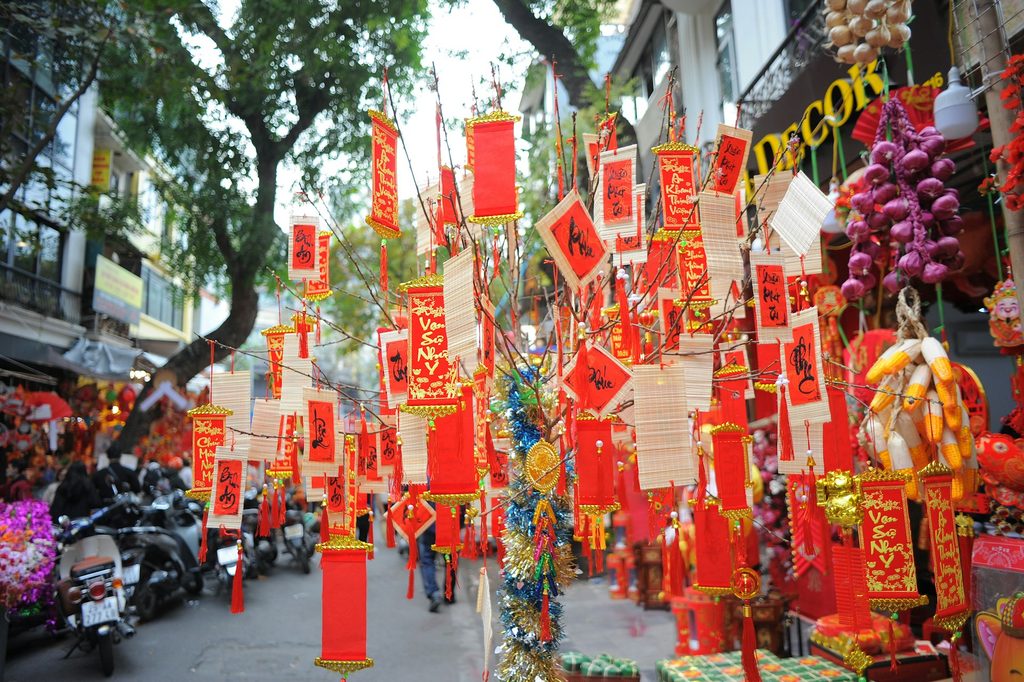
Hanoi Tube Houses: Why Are They So Narrow and Deep?
Now we get to one of the Old Quarter’s most recognisable features—the houses. Or, more accurately, the slightly bizarre-looking proportions of the houses.
You’ll often see buildings with extremely narrow façades that extend a surprisingly long way behind them. These are commonly known as tube houses, or nhà ống.
Traditional examples could be only a few metres wide but much deeper, with rooms arranged sequentially from the street towards the back.
So why build a house like that? One important part of the answer is taxation.
One important explanation for the narrow form is historical taxation based on street frontage. If the amount of frontage affected the tax you paid, there was a pretty obvious incentive to keep your frontage narrow and use the space behind it instead.
It’s an impressively practical response to a slightly annoying tax bill.
But taxation isn’t the whole story.
The Old Quarter had become a dense commercial area where land was valuable and buildings had to accommodate both business and domestic life.
A narrow plot could still be extremely useful because the front of the building could function as a shop or workshop and the family could live further back.
So instead of spreading sideways, the building grew backwards, which is why the phrase “tube house” is actually quite a useful description.
From the street, you see the opening, the building continues behind it, and sometimes it continues much further than you’d expect.
What’s Inside a Hanoi Tube House?
This is the part you can’t really understand from the pavement.
Traditional Old Quarter tube houses were often arranged as a sequence of rooms and courtyards running from front to back.
You could have a shop or entrance area at the front, followed by an internal courtyard, family living areas, another courtyard, a kitchen, and rear service spaces.
The courtyards were particularly useful for providing light and ventilation to a building that otherwise relied on the light and air from a small shop front.
The result was a long, layered building rather than one large open house.
The Mã Mây Heritage House is useful for understanding this arrangement because its restored interior preserves the traditional sequence of rooms and courtyards.
And once you understand what’s happening inside, the façades outside make much more sense.
You stop looking at a narrow building and thinking: “That’s a very small house.” Instead, you start wondering: “How far back does that actually go?”
It’s also worth remembering that the Old Quarter’s age and the age of its individual buildings aren’t the same thing.
The tube-house form is rooted in the area’s older architectural traditions, but the buildings you see today have been altered, rebuilt, extended, and replaced over generations.
So a tall, narrow building might preserve the shape of an older way of building without being an untouched historic house.
Hanoi Old Quarter Architecture: What Are You Actually Looking At?
The Old Quarter’s architecture isn’t one single style, which is another reason why it can be confusing.
There are traditional Vietnamese shophouses and tube houses, temples and communal buildings, and later buildings where different architectural traditions have been layered together.
The historic commercial houses often had sloping tile roofs and a shop entrance facing the street. Earlier houses were often simpler and had thatched roofs.
Then there are the religious buildings.
Before 1954, the area reportedly contained more than 100 religious structures, including temples, pagodas, communal houses, and shrines.
Most haven’t survived. But some have.
Bach Ma Temple, Mã Mây, and Kim Cổ are reminders that the Old Quarter wasn’t simply a collection of shops.
These were communities with their own religious and social institutions, and many craft streets once had temples dedicated to the mythical founders of their trades.
Some communal temples even had commercial activity on the ground floor, further blurring the line between the neighbourhood’s spiritual and commercial life.
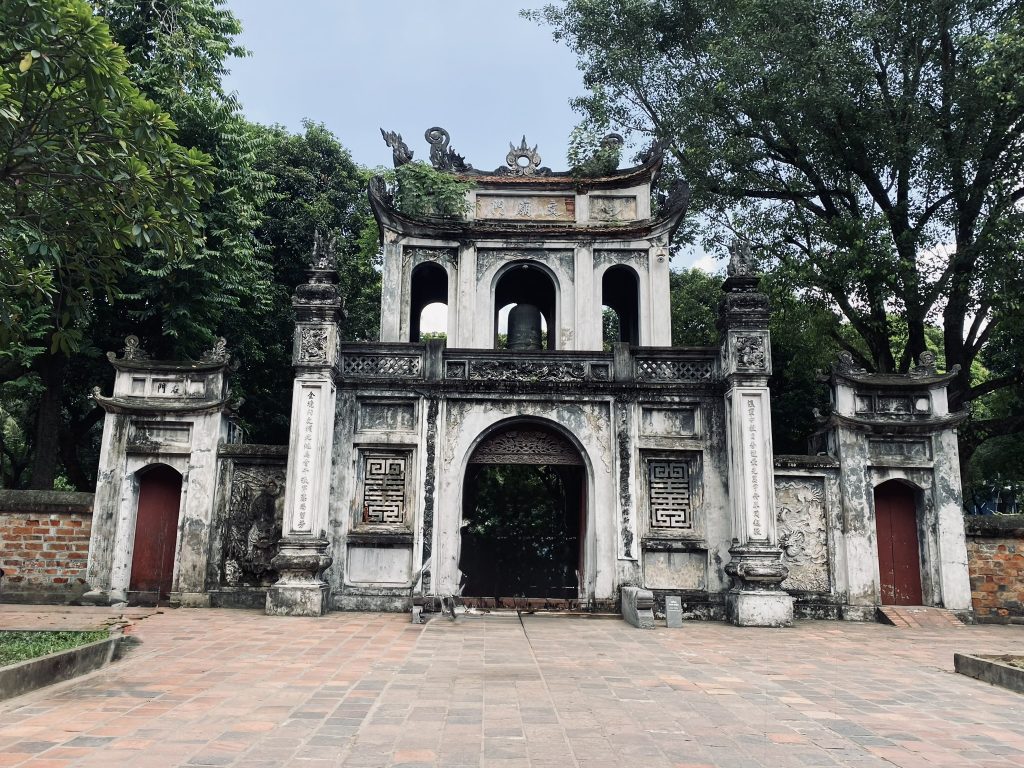
The Quan Chưởng Gate is another surviving piece of the older city. Several gates once stood around the area, but it is the only one that remains today.
And then, layered over all of this, you get French influence. Which brings us to one of Hanoi’s most useful comparisons.
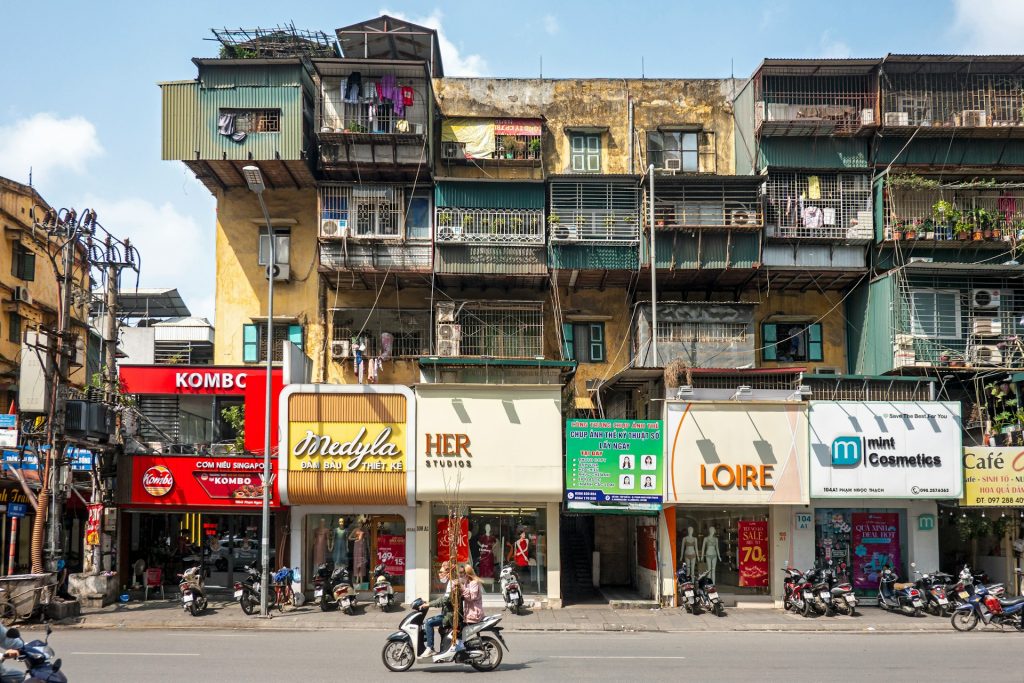
Why Does the Old Quarter Look So Different from the French Quarter?
Old Quarter
Walk from the Old Quarter towards the French Quarter and the difference can feel almost ridiculous.
One minute you’re navigating narrow streets between tightly packed buildings, then the roads widen and become tree-lined, and the buildings have grand colonial façades.
It can feel like someone has changed the city settings halfway through your walk. But the difference reflects two very different periods of urban development.
The Old Quarter had developed over centuries as a dense commercial area, with streets and plots shaped by existing communities, trade, and settlement.
During the French colonial period, Hanoi was partially remodelled.
The French introduced infrastructure including water, sewage, and electricity. A tramway was constructed through the Old Quarter, and two smaller markets were demolished to make way for Đồng Xuân Market.
French Quarter
At the same time, the French Quarter developed south of Hoàn Kiếm Lake with much broader streets and larger colonial buildings.
French and Indian businessmen also established themselves in the Old Quarter. So French influence wasn’t confined neatly to one side of the city. It also made its way into the Old Quarter itself.
Some traditional houses gained French-inspired façades, balconies, shutters, and decorative elements. That’s where the hybrid French-Vietnamese architecture comes in:
- A narrow Vietnamese tube-house structure might suddenly have European decorative details attached to it.
- A traditional roof might sit above a façade influenced by French design.
- And modern shopfronts can sit underneath older upper floors.
This is one reason I wouldn’t describe the Old Quarter’s architecture as simply “traditional Vietnamese”. It’s more like layer upon layer of Hanoi’s history occupying the same small amount of space.
Differences: Old Quarter vs French Quarter
If you want to understand the difference between the Old Quarter and French Quarter, you don’t actually need to know much architectural terminology.
Just look at the road:
- The Old Quarter’s streets are narrow because of how the district developed.
- The French Quarter’s broad avenues reflect a different approach to urban planning.
The city itself is showing you the difference.
What Happened to Hanoi Old Quarter?
This is where the idea of Hanoi Old Quarter as a perfectly preserved historic district falls apart a little. And that’s probably worth knowing before you visit.
The Old Quarter is ancient as an urban district, but it has never been frozen in time. The streets, trades, buildings, and communities have all changed over the centuries, so the neighbourhood you see today is the result of many different periods layered on top of one another.
Many of the traditional commercial houses visible today date from the 18th and 19th centuries, rather than from the founding of Thăng Long in 1010. Earlier buildings were rebuilt or replaced, while later generations continued to modify the houses around them.
During the French colonial period, parts of the Old Quarter were rebuilt and modernised. Water, sewage, and electricity infrastructure were introduced, a tramway was constructed through the quarter, and two smaller markets were demolished to make way for Đồng Xuân Market.
The 20th century brought further political and economic upheaval.
After 1954, Hanoi became the capital of independent North Vietnam. During the Vietnam War, the Old Quarter survived bombing, although some buildings were damaged, including during the 1972 Christmas Bombing.
After reunification in 1976, Hanoi became the capital of unified Vietnam. The following period of economic difficulty contributed to the deterioration of many old buildings.
Then came Đổi Mới in 1986.
Economic reforms opened up private enterprise and helped bring increased commercial activity and foreign tourism. The Old Quarter changed rapidly. More businesses arrived. Tourism grew. Buildings were renovated, extended, and rebuilt.
And while heritage preservation efforts also increased, many traditional houses have continued to disappear.
Hanoi Old Quarter Today
Because of the changes to the Old Quarter over the years, when you walk through it today, you’re seeing several different things at once:
- Some buildings are historic.
- Some preserve historic layouts.
- Some have been heavily altered.
- Some are much newer.
- Some traditional trades survive.
- Others survive mainly in street names.
- And some of the religious buildings that once formed an important part of the neighbourhood have disappeared completely.
The Old Quarter isn’t a time capsule.
It’s a neighbourhood that has spent centuries adapting to whatever Hanoi needed next.
How to Read Hanoi Old Quarter When You Walk
This is the part I’d actually use when you’re there.
You don’t need a checklist or to visit every historic building, and you definitely don’t need to know all of Hanoi’s dynasties before breakfast.
Instead, try reading the neighbourhood itself.
Start With the Street Names
When you see Hàng, look at the word that follows it.
- What does it mean?
- What was the street associated with?
- Does that trade still exist there?
You might start noticing that the neighbourhood’s commercial history is quite literally written on the signs.
Look Above the Shopfronts
The shops at street level are usually what grab your attention. But try looking up instead:
- How narrow is the building?
- Does it look as though it extends backwards?
- Can you spot French shutters, balconies, decorative details or different layers of construction?
The upper floors can tell you things the shopfront can’t.
Look Beyond the Façade
If you pass a particularly narrow house, try to work out what is behind it.
You may only see a tiny entrance from the street, but the traditional building form could extend much further back.
If you visit Mã Mây Heritage House, pay particular attention to the courtyards and the sequence of rooms. Then look at the next tube house you pass.
It suddenly becomes much easier to imagine what’s going on behind the façade.
Notice the Temples
The Old Quarter’s religious buildings are easy to overlook because they’re surrounded by commercial life. But that’s precisely why they’re worth noticing.
The craft communities didn’t just bring their trades into Hanoi; they brought their beliefs and traditions too.
A temple tucked between shops is therefore part of the same story as the trade streets.
Then Walk Towards the French Quarter
This is the easiest comparison of all.
Pay attention to space, road width, building width, plot size, the amount of open space, and the relationship between buildings and streets.
You can physically walk from one urban system into another. And suddenly the question “Why does Hanoi look like this?” becomes much easier to answer.
If you’re using Hanoi as a starting point for exploring the region, I’ve also put together a Northern Vietnam guide covering more of what there is to see beyond the capital.
The thing I like about learning the history of a place is that it doesn’t necessarily make the place feel less chaotic.
Hanoi’s Old Quarter is still busy, the streets are still narrow, and there are still moments when you have absolutely no idea how three motorbikes, a delivery truck, and a pedestrian are all going to fit through the same gap.
But now I notice different things.
I notice the street names, I look up at the buildings, I wonder how far the narrow houses extend behind their façades, I notice when a traditional building has picked up French details somewhere along the way.
And when I walk towards the French Quarter, I notice the change in space rather than simply thinking that the buildings look different.
That’s what makes the Old Quarter interesting to me.
You don’t need to find a hidden street or a secret attraction to experience a different side of Hanoi. Sometimes you just need to understand what you’re already looking at.
And once you do, the Old Quarter stops looking like a collection of random narrow streets and starts looking a lot more like what it really is:
centuries of Hanoi, still visible in the shape of the city.
Roamwise by Leaf — Practical guides. Forgotten stories. Meaningful journeys.