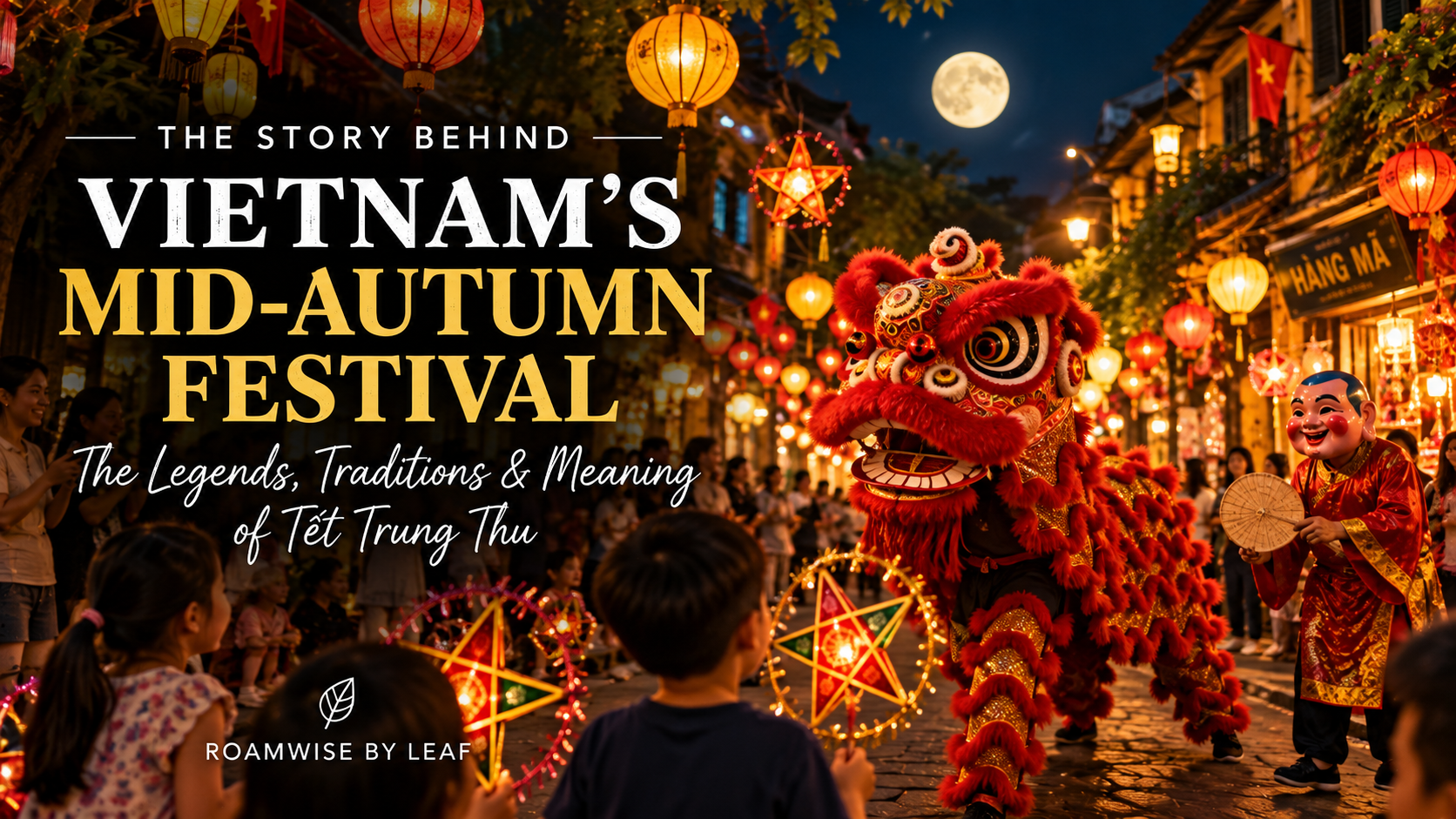
I first got to know Vietnam’s Mid-Autumn Festival through the fun bits: lion dances in Hanoi, evenings celebrating with friends, and mooncakes that I was very happy to eat without asking too many questions.
But I eventually realised I didn’t actually know what I was celebrating.
Why the lanterns? Why the lions? Why mooncakes? And who exactly is Chú Cuội, the man apparently living on the moon beneath a banyan tree?
The more I looked into Tết Trung Thu, the more interesting it became. What looks, at first, like a colourful festival for children is tied to much older stories, traditions, the full moon, family, and the harvest.
So this is me finally finding out what all those things I’ve been enjoying actually mean.
When Is Vietnam’s Mid-Autumn Festival?
Tết Trung Thu is Vietnam’s Mid-Autumn Festival, celebrated on the 15th day of the eighth lunar month.
In 2026: 25 September
What to look for: Star lanterns, lion dances, mooncakes, and plenty of children running around under the full moon
Where: Celebrated throughout Vietnam
So Why Is the Full Moon So Important in Mid-Autumn Festival?
Tết Trung Thu is celebrated on the full moon of the eighth month of the lunar calendar, traditionally marking an important point in the agricultural year.
For an agricultural society, the end of the growing season was a pretty significant moment. There was work to celebrate finishing, crops to be thankful for, and, importantly, a bit more time to spend together.
The full moon also became associated with reunion and togetherness. There’s something rather fitting about a festival built around the roundest, brightest moon of the year becoming a time for families to gather, share food, and look at the moon together.
And this is where I think the modern festival can be slightly misleading.
These days, it’s very easy to look at Tết Trung Thu and think: children + lanterns + lion dances + mooncakes.
But underneath all of that is a much older idea: the moon, the harvest, and people coming together.
Which brings us to the slightly surprising question:
How did a festival with such strong agricultural and family connections become known as Vietnam’s Children’s Festival?
When Did Tết Trung Thu Become a Children’s Festival?
This is one of those things I initially assumed had always been the case. It hadn’t.
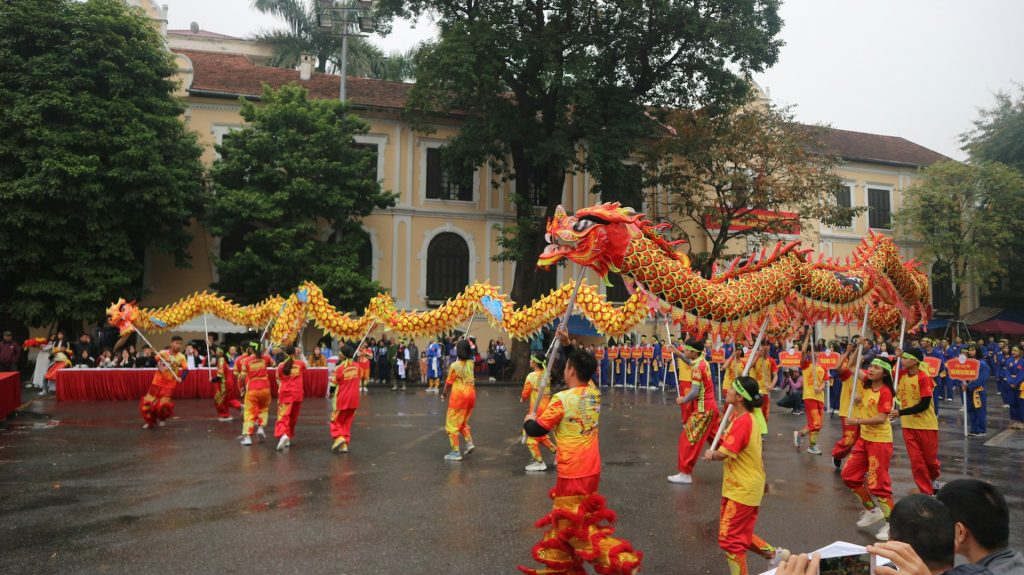
Children are absolutely at the centre of modern Vietnamese Trung Thu. They’re given lanterns and toys, they lead lantern processions, and they’re the ones getting particularly excited when the lion dancers arrive.
Historical accounts show that Mid-Autumn celebrations weren’t originally centred solely around children. At Thăng Long, for example, records from the Lý dynasty describe celebrations taking place both at court and among ordinary people, with feasting, ancestral worship, and public festivities.
Over time, though, children became increasingly central to the festival. And honestly, once you see Trung Thu in Vietnam, it makes perfect sense.
The festival gives children an entire night of things designed specifically for them: lanterns to carry, songs to sing, lion dances to chase after, sweets to eat, and an excuse to stay up late.
But there is one character who makes the whole thing considerably more interesting.
Because apparently, there is a man living on the moon.
Who Is Vietnam’s Chú Cuội?
If you’ve spent any time around Vietnamese children during Trung Thu, you’ve probably encountered Chú Cuội.
Or, more accurately, you’ve probably encountered his face without having any idea who he was.
According to Vietnamese legend, Cuội was a man who owned a magical banyan tree. The tree had extraordinary healing powers, but after a series of events, Cuội ended up clinging to it as it was pulled towards the moon.
He never made it back.
So Vietnamese folklore says that if you look carefully at the moon, you can see Cuội sitting beneath his banyan tree.
It’s a wonderfully odd explanation for the shapes you can see on the moon.
And it also explains why the moon features so heavily in Vietnamese children’s stories around Trung Thu.
There are other Mid-Autumn moon legends across Asia, of course. If you’ve encountered the Chinese story of Chang’e, you might recognise some of the broader moon mythology, but the Vietnamese story is its own thing.
That’s one of the things I find most interesting about festivals like this. Traditions travel, stories evolve, and different cultures make them their own.
Why Do Vietnamese Children Carry Star Lanterns?
The đèn ông sao, or star lantern, is one of the most recognisable symbols of Trung Thu. But the tradition isn’t just about giving children something pretty to carry.
The lanterns are carried through the streets during Trung Thu processions, often alongside the drums and lion dancers.
The connection to Cuội explains why children carry lanterns. According to the legend, the lights help guide him back to Earth from the Moon.
So when children parade through the streets carrying their glowing đèn ông sao, they’re lighting Cuội’s way home.
Traditionally, đèn ông sao were made from bamboo frames covered in coloured paper or cellophane, with a candle inside. Today you’ll find plenty of modern versions, but the five-pointed star remains the classic.
And once you know the story, those little lanterns feel like more than just decorations.
Why Are Lions Running Around Hanoi?
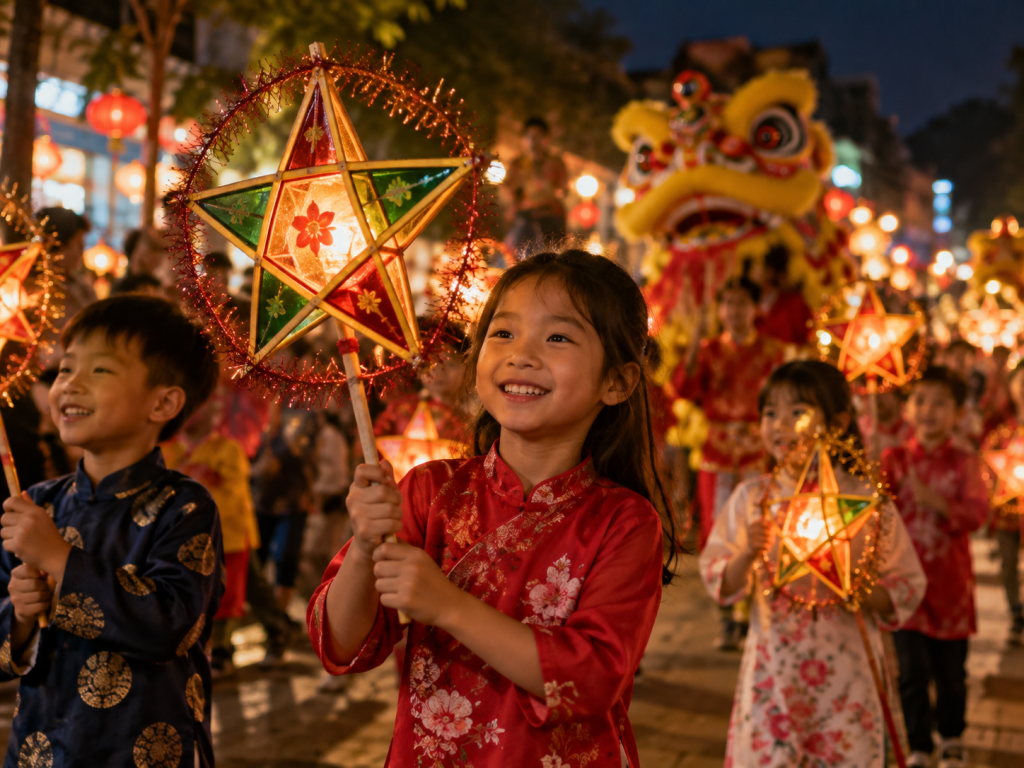
The first time you experience múa lân during Trung Thu, subtlety is not really the word I’d use.
You hear the drums before you see anything.
Then suddenly there’s a lion dancing down the street, children are running after it, people are leaning out of doorways, and everyone is inevitably trying to get a better view.
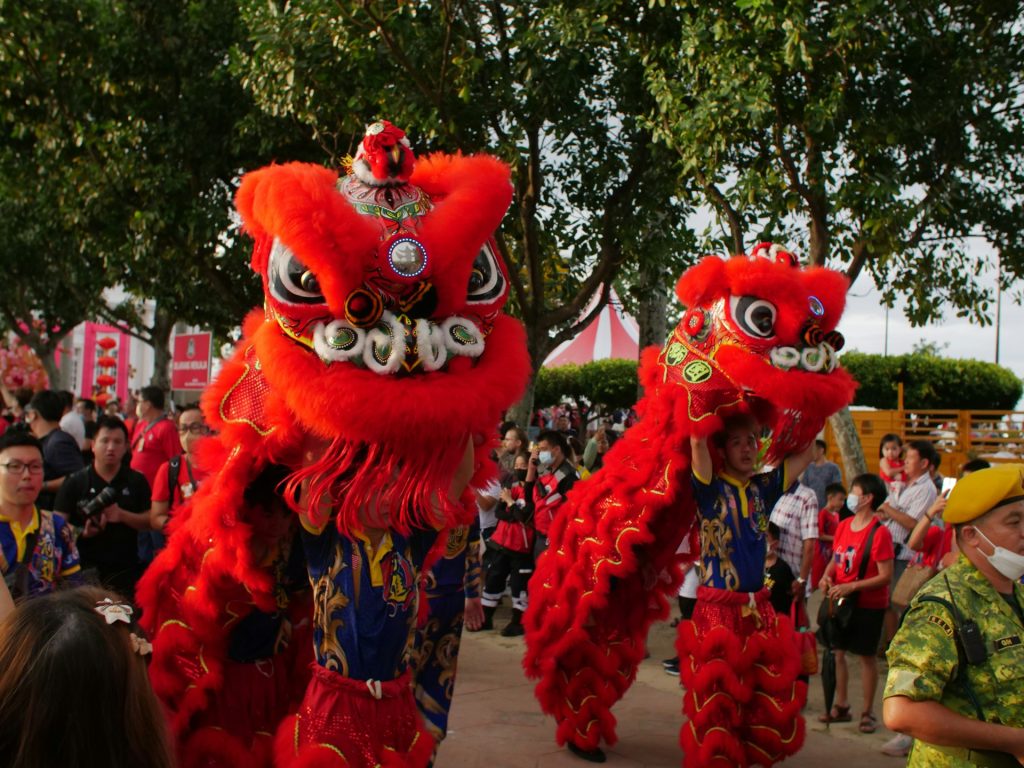
I’ve watched lion dances in Hanoi, and this is probably one of my favourite parts of experiencing Vietnam’s Mid-Autumn Festival.
But what I didn’t initially realise was that the lion isn’t there purely for entertainment.
Múa lân is associated with good fortune and prosperity, and lion dancing has become one of the defining performances of Vietnamese Mid-Autumn celebrations.
You may also see Ông Địa, the cheerful, round-bellied character with the enormous grin and fan, accompanying the lion.
He represents the Earth God, protector of land and homes, and is closely associated with the joyful, playful side of the performance.
The whole thing is therefore doing several jobs at once:
- It’s entertainment for children
- It’s a communal celebration
- And it’s also a performance associated with good luck and abundance
Which makes the ridiculous amount of drumming slightly more understandable. Not much more… But slightly.
And Then There Are Mid-Autumn Mooncakes
I will admit that I approached Vietnamese mooncakes from a position of considerably less intellectual curiosity.
I saw them. I ate them. I enjoyed the sweet ones. That was pretty much the extent of my research.
Naturally, there’s more to them than that.
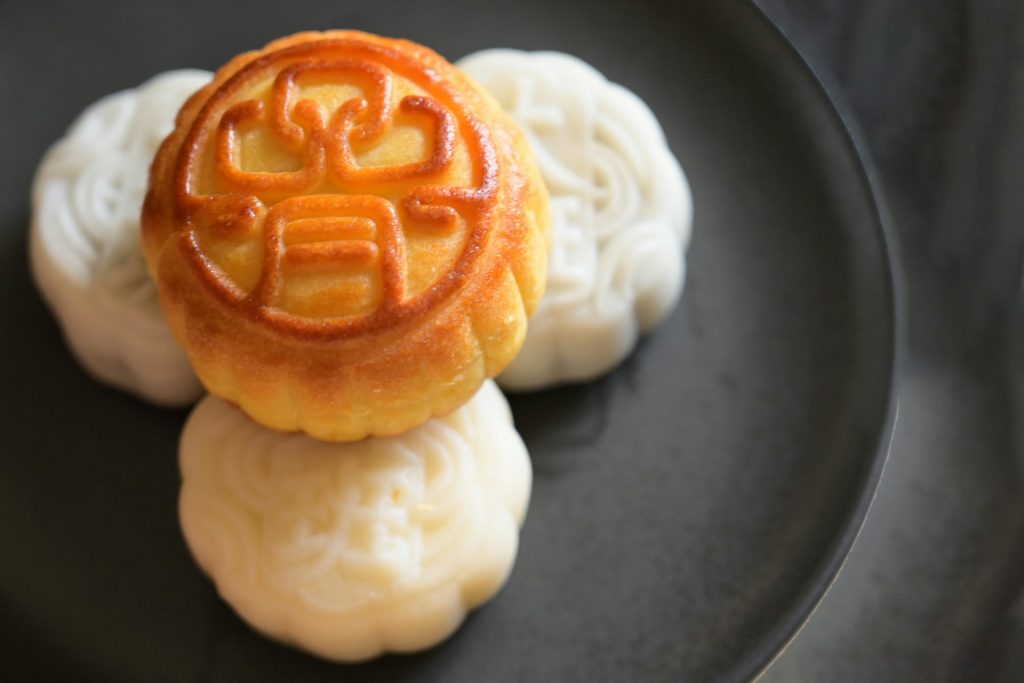
Mooncakes are traditionally eaten during Mid-Autumn celebrations across East and Southeast Asia, with Vietnam developing its own versions over time.
The two traditional types you’ll hear about most often are bánh nướng, the baked mooncake, and bánh dẻo, the soft, chewy version made with glutinous rice flour.
Fillings range from mung bean and lotus seed to the savoury combinations found in traditional thập cẩm mooncakes.
Personally, I’m firmly on the sweet mooncake side. No hesitation. Plus, I’m vegetarian, and savoury mooncakes tend to have meat inside.
But there’s a reason they’re associated with the festival beyond simply being the seasonal cake that appears in every bakery for several weeks.
Their round shape connects them with the full moon, while sharing mooncakes with family and friends reflects the wider idea of reunion and togetherness. They can also be placed on the family altar as offerings to ancestors.
So yes, I was eating them because they were delicious. Apparently, I was also participating in several centuries of symbolism. I’ll take that.
So How Does Each Tradition Fit Together in Vietnam’s Mid-Autumn Festival?
I’d initially been treating all of these things as separate parts of Trung Thu.
The moon was the moon. The mooncakes were the mooncakes. The children had their lanterns, and the lions came with their drums.
But the more I looked into the festival, the harder it became to separate them.
The full moon connects back to the agricultural calendar. Mooncakes and fruit are shared with family and can be offered to ancestors. The lanterns and lion dances have become part of the children’s celebrations.
It turns out I hadn’t been watching lots of different traditions. I was looking at one festival that had accumulated layers over time.
What Does Vietnam’s Mid-Autumn Festival Look Like Today?
The festival isn’t a show that happens in one particular tourist city. It’s celebrated throughout Vietnam, and much of what makes it enjoyable is simply seeing how it appears in everyday neighbourhoods.
I’ve experienced it in Hanoi, where the combination of lanterns, mooncakes, friends, children, and sudden explosions of lion-dance drumming makes it difficult to miss. It’s also a good excuse to explore the city’s old streets, which have their own fascinating history and character.
But you don’t need to be standing in a famous festival square to experience it.
Where To See Vietnam’s Mid-Autumn Festival in 2026
If you want to see Vietnam’s Mid-Autumn Festival in 2026, Tuyên Quang is one of the places I’d have on my list.
The city’s Thành Tuyên Festival has become famous for enormous illuminated Mid-Autumn lantern models, turning the traditional lantern procession into something considerably more spectacular.
In 2026, the festival runs from 19–25 September, with the main celebration on 20 September and a procession featuring 40 large Mid-Autumn lantern models.
It’s not necessarily the “best” place to experience Trung Thu, but it is a particularly striking example of how the traditional festival has evolved.
The little star lantern is still there — it’s just been scaled up rather dramatically.
Planning To Explore Northern Vietnam? My Northern Vietnam travel guide covers where to go and how to plan your trip.
I think the funny thing is that I haven’t actually changed how I celebrate Tết Trung Thu.
I’ll still happily watch the lion dances. I’ll still go out with friends. And if someone offers me a sweet mooncake, I’m still saying yes.
I just know a bit more about what I’m looking at now.
The next time I see children carrying those little star lanterns through Hanoi, I’ll think about Cuội and his banyan tree on the moon.
When the drums start, I’ll know why the lion has turned up. And when the mooncakes appear, I’ll probably think about the centuries of tradition for approximately three seconds before eating one.
Some things are better understood without becoming any less fun.
And I think that’s what I like about learning the story behind a place or tradition. You don’t need to turn yourself into a historian to appreciate it.
Sometimes you just need to know enough to look at something familiar and think:
Oh. So that’s why.
Roamwise by Leaf — Practical guides | Forgotten stories | Meaningful journeys